SACEUR Presents NATO’s Theory of Victory at the WSF

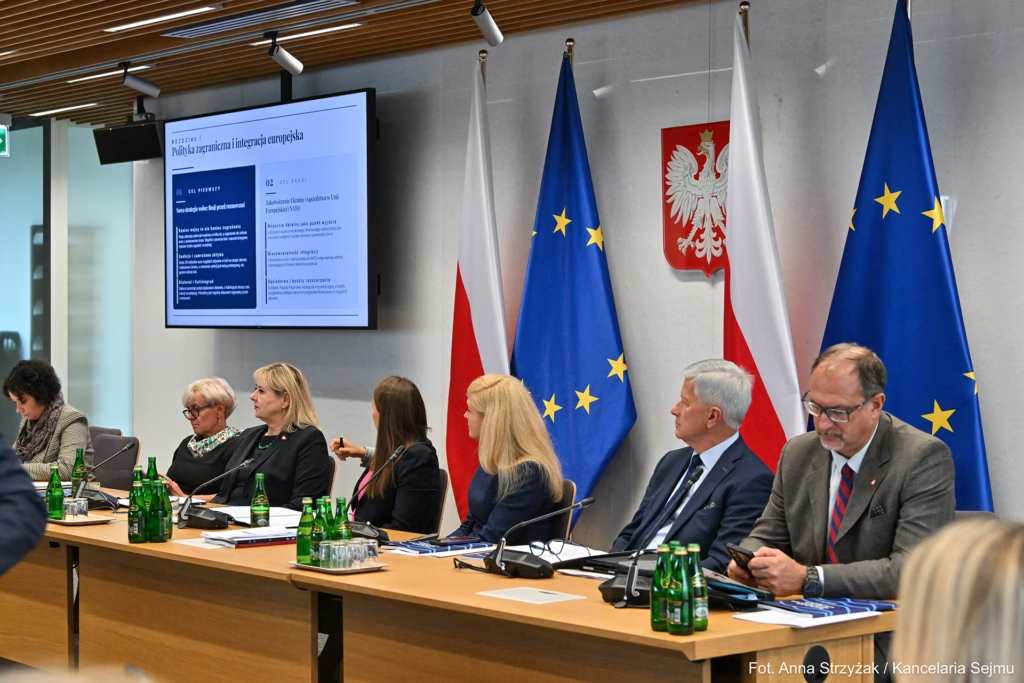
On 12 October, NATO’s Supreme Allied Commander Europe, Gen. Alexus G. Grynkewich, presented the Alliance’s Theory of Victory at the 13th Annual Gathering of the Warsaw Security Forum. The session, Theory of Victory: How Do We Achieve Military Success Against Russia in Deterrence and Defence?, was moderated by Prof. Katarzyna Pisarska, Chair of the Warsaw Security Forum. It marked the first public presentation of a concept finalised in classified form three months earlier and grounded in the Alliance’s strategy for the Deterrence and Defence of the Euro-Atlantic Area, agreed by all 32 Allies. Announced in advance as one of the highlights of this year’s programme and held in a session sponsored by NATO, the presentation was met with repeated applause on the Forum’s main Warsaw Stage.
The General opened by recalling that NATO is a defensive Alliance with no ambitions beyond the protection of its people and the defence of its territory, adding: „But if someone is foolish enough to attack us, we will fight.” SACEUR paid tribute to Poland, which since joining NATO in 1999 has led by example through historic investment in defence and rapid military modernisation.
Three Steps: Block, Blunt, Break
At the core of the Theory of Victory is a denial defence in three steps. First, Allied land forces, supported by air, maritime, space and cyber forces, would block an attack at the point of contact and deny the seizure of Allied territory. If the attack persists, advanced sensors, autonomous systems and multi-domain forces would blunt it and prevent any further advance. Should the adversary press on or commit reserves, NATO would break the warfighting system engaged against it: „not just the attacking force itself, but anything and everything that supports, sustains, or controls that force.”
General Grynkewich stressed that the concept is a common vision for how the Alliance wins in deterrence and defence rather than a war plan. Its aim is limited: to stop an attack in its tracks, not to impose a strategic defeat on the adversary. Since NATO would strike only the system attacking it, the burden of escalation would rest on the aggressor alone.
Allies are already taking steps to put the concept into practice. Forward Land Forces on the eastern flank will exercise and demonstrate their ability to block an attack, air and maritime forces their ability to blunt it, while investment in long-range precision strike, sensor networks and a warfighting cloud will underpin the capacity to break an aggressor’s system. Every exercise and every investment, the General noted, serves first and foremost to deter, so that these capabilities never have to be used.
Why Now
Asked by Prof. Pisarska why he had decided to go public, and why in Warsaw, the General pointed to the wave of sabotage and arson across Europe, which has left societies unsettled. His aim, the General said, was to reassure the Alliance’s one billion citizens and to make clear to any potential adversary that NATO knows exactly how it would respond. SACEUR underlined that he does not assess conflict to be imminent or inevitable, while making clear that the Alliance’s forces are ready today and are growing more ready every day: „We’re rehearsed, and we’re ready.”
The General also set out how Allies should respond to Russia’s hybrid campaign: by attributing attacks publicly once the evidence allows, by answering each incident with stronger support for Ukraine, including air defence interceptors, and by coordinating their messaging so that Moscow receives a clear statement of the Alliance’s red lines. On stockpiles, he described the Alliance as prepared today, while calling on industry to build the capacity to sustain a fight over time, not only to deliver new capabilities.
In the conversation that followed, General Grynkewich explained that the concept accounts for simultaneous crises in Europe and the Asia-Pacific and draws on the lessons of the wars in Ukraine and the Middle East, from the need for large quantities of affordable systems to the role of drones and electronic warfare. The General praised Ukraine for stabilising the front line and expressed confidence that Ukrainians would come through another winter of Russian attacks on their energy system. Asked about the American commitment to European security, SACEUR recalled the Allies’ pledge at the Ankara Summit and stated that „no one should question the commitment of the United States to this alliance.” His message to the audience was one of confidence: „Unity is our strength.”
General Grynkewich closed his address with words addressed to Allies and adversaries alike: „We know how we will fight if a fight comes to us, and we know we will win.”
The full session is available on the WSF YouTube channel.
Gallery