Warsaw Security Forum 2026 – United We Stand

On 12-13 October, the 13th Annual Gathering of the Warsaw Security Forum, organised by the Casimir Pulaski Foundation with Norway as Partner Nation, brought together Presidents and Prime Ministers, including Donald Tusk of Poland, Jonas Gahr Støre of Norway and Mindaugas Sinkevičius of Lithuania; foreign and defence ministers from across Europe, European Commissioners, NATO’s leadership and a bipartisan delegation of the US Congress, while President Volodymyr Zelenskyy of Ukraine joined by video link.
This year’s edition welcomed 2,872 participants from 90 countries, among them 399 speakers and distinguished guests and 422 members of official delegations. In the margins of the debates, participants held 300 bilateral meetings, while 371 accredited journalists carried the discussions to audiences far beyond the conference halls. The Forum was made possible by more than 110 partners, from Polish and allied institutions to industry, think tanks and the media.
The Forum met in a week that put allied unity to the test. Days before it opened, Washington announced a deal with Moscow on Russian diesel exports, followed by an energy ceasefire that Kyiv learned of from the media and that Russia met with fresh strikes on Ukraine’s power grid. Against this background, the debates in Warsaw returned to the same agenda: ending Russia’s war against Ukraine on terms that secure a lasting peace, keeping the United States anchored in European security, and building the military, industrial and societal strength on which credible deterrence rests.
No Illusions about Russia
On Monday, 12 October, Prof. Katarzyna Pisarska, Chair of the Warsaw Security Forum, opened the Annual Gathering by recalling that a year earlier the Forum had met under the warning #DividedWeFall. The months since have shown that Europe can carry the burden: Russia is suffering immense losses, Ukraine is fighting effectively and Europe has committed EUR 90 billion in support. Yet Moscow has raised next year’s budget by 27% and intensified its hybrid campaign against Europe, which proves that Russia is preparing for war rather than peace. The danger, Prof. Pisarska argued, lies in Russia turning its resources into weapons faster than Europe turns its resources into decisions. From this diagnosis followed three calls: to transfer Russia’s frozen assets to Ukraine, to deliver the interceptors that close Ukraine’s skies, and to strengthen rather than ease sanctions pressure on Moscow.
Stand with Ukraine not as long as it takes, but with everything it takes.
Prof. Katarzyna Pisarska
Chair of the Warsaw Security Forum
Prime Minister Donald Tusk placed full responsibility for the war on Russia and warned that any attempt to present it as a conflict with shared blame serves the aggressor. Moscow, Prime Minister said, seeks domination rather than a ceasefire or de-escalation, and announced that he would press European partners in Brussels to consider tougher sanctions. Poland, Prime Minister assured, would send no signal of yielding to Russian intimidation or of weakening its support for Ukraine. Warsaw, in his words, was the right place and the right time for a debate on the security of Poland, Europe and Ukraine.
Europe, NATO, and the entire free world will not be broken or intimidated.
Donald Tusk
Prime Minister, Poland
Addressing the Forum online, President Volodymyr Zelenskyy said that Kyiv had learned of the announced energy ceasefire from the media, while Russian strikes on Ukrainian energy facilities continued, including a power plant in Kharkiv. Ukraine, he declared, would respect a mutual halt to strikes on energy infrastructure as soon as Russia did the same. What the moment requires is American pressure on Moscow, not sanctions relief or concessions. The President warned that Ukrainian intelligence had identified Russian plans for numerous hybrid operations against European states, and appealed for munitions for Ukraine’s F-16s, air defence interceptors and funding for domestic arms and drone production, as well as closer defence-industrial cooperation with Poland. President Zelenskyy closed with a call to allow no pauses in Ukraine’s path to the European Union, so that Ukrainians, facing another winter of war, can see their European future within reach.
We need to end Russia’s war. We need to guarantee security. We need to stand together – Europe and the United States.
Volodymyr Zelensky
President of Ukraine
In conversation with his Norwegian counterpart, Prime Minister Mindaugas Sinkevičius of Lithuania argued that Europe must earn its place in decisions on its own security: „No one will offer us, Europeans, a seat at the decision-making table out of courtesy alone.” Commitments, he added, must turn faster into capabilities, because „strategies and plans are essential, but they are not what deters Russia.” Prime Minister Jonas Gahr Støre urged states with leverage over Moscow, China and India among them, to bring Russia to the negotiating table, and called on Europe to plan now for its security after the war.
SACEUR unveiled NATO’s Theory of Victory
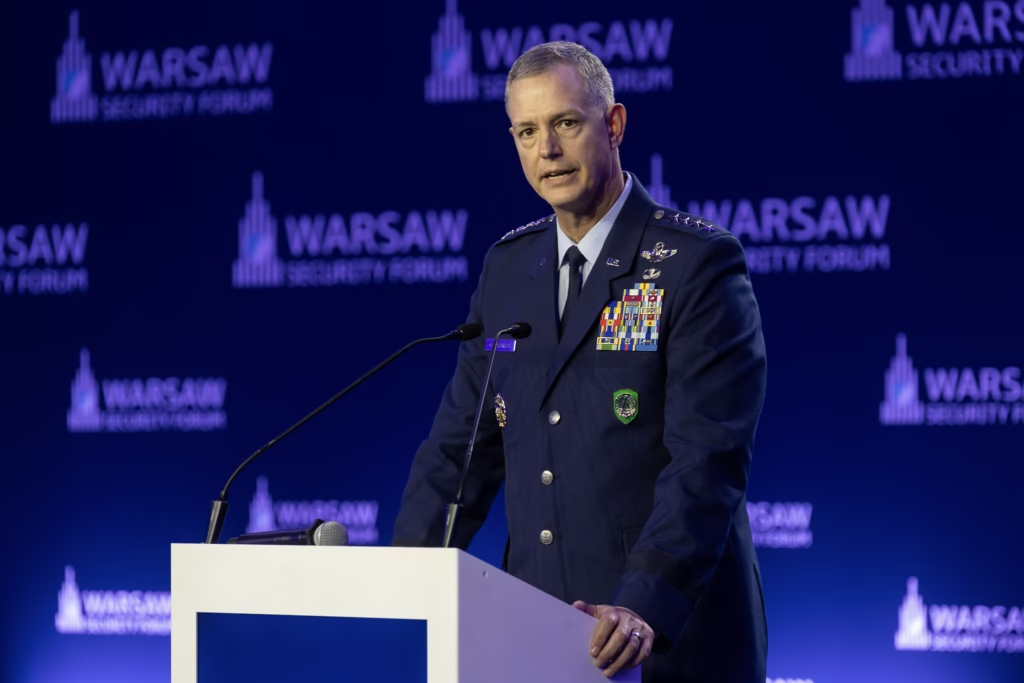
The defining moment of the first day came when NATO’s Supreme Allied Commander Europe, Gen. Alexus G. Grynkewich, presented his Theory of Victory in public for the first time. Grounded in the strategy for the Deterrence and Defence of the Euro-Atlantic Area agreed by all 32 Allies and in the lessons of the wars in Ukraine and the Middle East, it sets out a denial defence in three steps. NATO will block an initial attack, blunt it if it persists and, if required, break the forces and the warfighting system arrayed against the Alliance. Its aim is to deny any seizure of Allied territory, leaving the burden of escalation squarely on the aggressor.
Unity is our strength
Gen. Alexus G. Grynkewich
Supreme Allied Commander Europe, NATO
NATO’s senior leadership carried the same message across the programme. The Chair of the NATO Military Committee, Adm. Giuseppe Cavo Dragone, assessed that in military terms the Alliance has never been stronger while NATO’s Deputy Secretary General Radmila Šekerinska addressed the many forms that hybrid attacks now take and the role of national instruments as the first line of response.
Can Europe Defend Itself?
Europe’s defence ministers took up the question that ran through the Forum in a panel of that title. Norway’s Tore O. Sandvik argued that Europeans who want the United States to stay should spend more on defence, and those who expect it to leave should spend even more, since deterring a war costs far less than fighting one. The Netherlands’ Deputy Prime Minister Dilan Yeşilgöz-Zegerius described how her country learns from Ukraine, from battlefield data to joint drone production, and drew a line under years of underinvestment: „We’re done with being naive.” Hungary’s Romulusz Ruszin-Szendi set out his new government’s ambition to bring Hungary back to Europe and to move from 2% towards 5% of GDP on defence, while Commissioner Andrius Kubilius named the fragmentation of Europe’s defence industry as its central weakness, noting that Ukraine may face around 2,000 Russian ballistic missiles this year against an annual PAC-3 output of about 700.
Deputy Prime Minister and Minister of National Defence Władysław Kosiniak-Kamysz opened the panel “How Can Europe Build the Military Power It Needs?”, pointing out that Poland has secured EUR 44 billion under the EU’s SAFE instrument and committed two-thirds of it to its own defence industry. The Minister called for European supply chains and maintenance lines on European soil, including for Patriot missiles, and for a permanent US presence in Poland that would allow Warsaw to take on more responsibility for the Eastern Flank. In the margins, the Minister met his counterparts from Belgium, Hungary, Kosovo, Lithuania, the Netherlands and Norway. Lithuania’s Minister of National Defence Robertas Kaunas left no doubt about his country’s resolve: „We will fight, we will defend our home.”
Honouring Courage
The second day opened with a ceremony honouring courage in the defence of freedom. Kateryna “Ptashka” Polishchuk, the Ukrainian combat medic who treated the wounded in the bunkers of Azovstal, survived Russian captivity and returned to the front, received the inaugural Lord Ashcroft Award for Courage from its founder, Lord Ashcroft, with a laudation by Gen. David Petraeus. In her remarks, “Ptashka” spoke of the Ukrainian prisoners of war still held by Russia and asked Europe for partnership in the fight that Ukraine continues to wage. Foreign Minister of Ukraine Andrii Sybiha, who joined the ceremony, called for intensified efforts to secure their release.
Lt. Gen. (Ret.) Keith Kellogg, former US Special Envoy for Ukraine, received the Jack Strong Award 2026, granted in memory of Gen. Ryszard Kukliński, the Polish officer who passed Warsaw Pact secrets to the United States during the Cold War. A veteran whose service spans more than five decades, from Vietnam to the National Security Council, Gen. Kellogg was honoured for his contribution to the security of the Euro-Atlantic community.
Sanctions and Frozen Assets
On the second day, the panel “The Return of Power Politics: Europe Between War and Rivalry”, moderated by Prof. Katarzyna Pisarska, brought together the foreign ministers of Poland, the United Kingdom, Germany and Norway, a day after the European Union adopted its largest single package of sanctions listings. Deputy Prime Minister and Minister of Foreign Affairs of Poland Radosław Sikorski drew a red line on Russia’s frozen sovereign assets, saying any return of them to Moscow would happen only „over our dead bodies.” He argued that wars end by persuading the aggressor to limit his ambitions rather than by asking the victim to capitulate, and that Putin has only two cards left: covert mobilisation and the winter. If Europe delivers on its commitments from The Hague and Ankara, by the end of the decade it will field armies that Russia cannot successfully attack.
German Foreign Minister Johann Wadephul set out Berlin’s position in one line: „This is not the time to lower the sanction regime, but to strengthen it.” Having met Sergei Lavrov in New York, the Minister saw no sign of Russian readiness for a ceasefire and called for any truce to extend to the Black Sea. UK Foreign Secretary Ed Miliband urged allies to hold Moscow to a full energy ceasefire: „Last week alone we’ve seen 200 Russian attacks on Ukrainian energy infrastructure.” The Secretary named fiscal support, energy support and tighter sanctions as the priorities for the winter, and said Britain was ready to act on the frozen assets. Norwegian Foreign Minister Espen Barth Eide warned that the way the war ends will cast long shadows over Europe’s future security, which makes its outcome a matter for the whole continent.
A Bipartisan Voice from Capitol Hill
Senator Roger Wicker, Chairman of the Senate Armed Services Committee, led a bipartisan congressional delegation that included Senators Kevin Cramer and Gary Peters and Representatives Jason Crow, Dan Crenshaw, Jim Himes and Marc Veasey. In the debate “Will the Transatlantic Alliance Hold?”, moderated by the Munich Security Conference Chairman, Wolfgang Ischinger, Senator commended the Allies reaching the 5% target ahead of schedule as a signal that the United States must also deepen its commitment. Asked about the US-Russia diesel deal, the Senator acknowledged the unease it had caused across the Alliance and judged it unlikely to come to fruition.
The members of Congress were present across the programme. Representative Crow joined Baroness Catherine Ashton, Adm. (Ret.) Rob Bauer and Robert Habeck in the debate “The West Under Attack: Confronting Malign Powers”, Representative Crenshaw discussed lessons from decades of American war and diplomacy with Gen. Keith Kellogg and Gen. David Petraeus, and Representatives Himes and Veasey spoke on strategic stability, intelligence and energy resilience. Members of both parties stressed that Washington will continue to need strong and capable European allies, and supported a NATO in which Europe carries a greater share of the burden.
US Permanent Representative to NATO Matthew G. Whitaker joined the debate “NATO 3.0: Keeping the Americans In, the Russians Out, and the EU Up”, and confirmed on the margins that the supply of US weapons to Ukraine financed by European Allies continues. Former US Secretary of Defense Lloyd Austin reflected on what it will take to win the next war, while an Night Owl session examined how the US midterm elections could shape the future of NATO.
Norway, Partner Nation of WSF 2026
As Partner Nation, Norway was present across the entire programme, the culmination of a year of cooperation that took Forum delegations to Oslo. Foreign Minister Espen Barth Eide, Minister of Defence Tore O. Sandvik and Minister of Climate and Environment Sigrun Aasland, who spoke on security and sustainability in the Arctic, were joined by Norway’s military leadership. Norway’s growing role on NATO’s eastern flank, from NASAMS air defence protecting Lithuanian airspace to Kongsberg’s new plant in Poland, gave the partnership a tangible military dimension, while the WSF 2026 Annual Report, Securing Europe from the Eastern Flank to the High North, provided its analytical frame.
Beyond the Main Stage
The Annual Gathering was accompanied by a programme of side events, among which the reception at the Presidential Palace held a distinguished place. On behalf of the President of the Republic of Poland, Karol Nawrocki, the Forum’s speakers were welcomed by Secretary of State Marcin Przydacz, Head of the International Policy Office, and Secretary of State Bartosz Grodecki, Head of the National Security Bureau.
Looking Ahead
The Warsaw Security Forum thanks all speakers, participants, partners and volunteers who made its 13th edition a living expression of this year’s message. At a time when unity can no longer be taken for granted, the community gathered in Warsaw showed what United We Stand means in practice. Recordings of the Forum’s sessions are available on the WSF YouTube channel and photographs in the WSF 2026 gallery.
The work of the Forum continues throughout the year. The conclusions of the WSF 2026 Annual Report will now be presented in the parliaments of other states of the region, and the Forum’s Strategic Dialogues, Public Dialogues and Parliamentary Diplomacy missions will carry the debate from Warsaw to allied capitals.
Save the date: the Warsaw Security Forum 2027 will take place on 27-28 September 2027.
Gallery